
Our approach
What does end-to-end product design actually mean?
True end-to-end product development means taking an idea all the way from the first evaluation through to a product that is costed, tested, manufactured, and ready for market with one team that owns the entire journey. It is not just design. It is not just engineering. It is the disciplined combination of both, grounded in commercial reality at every stage, so that when you commit to production, nothing is a surprise and nothing is wasted.
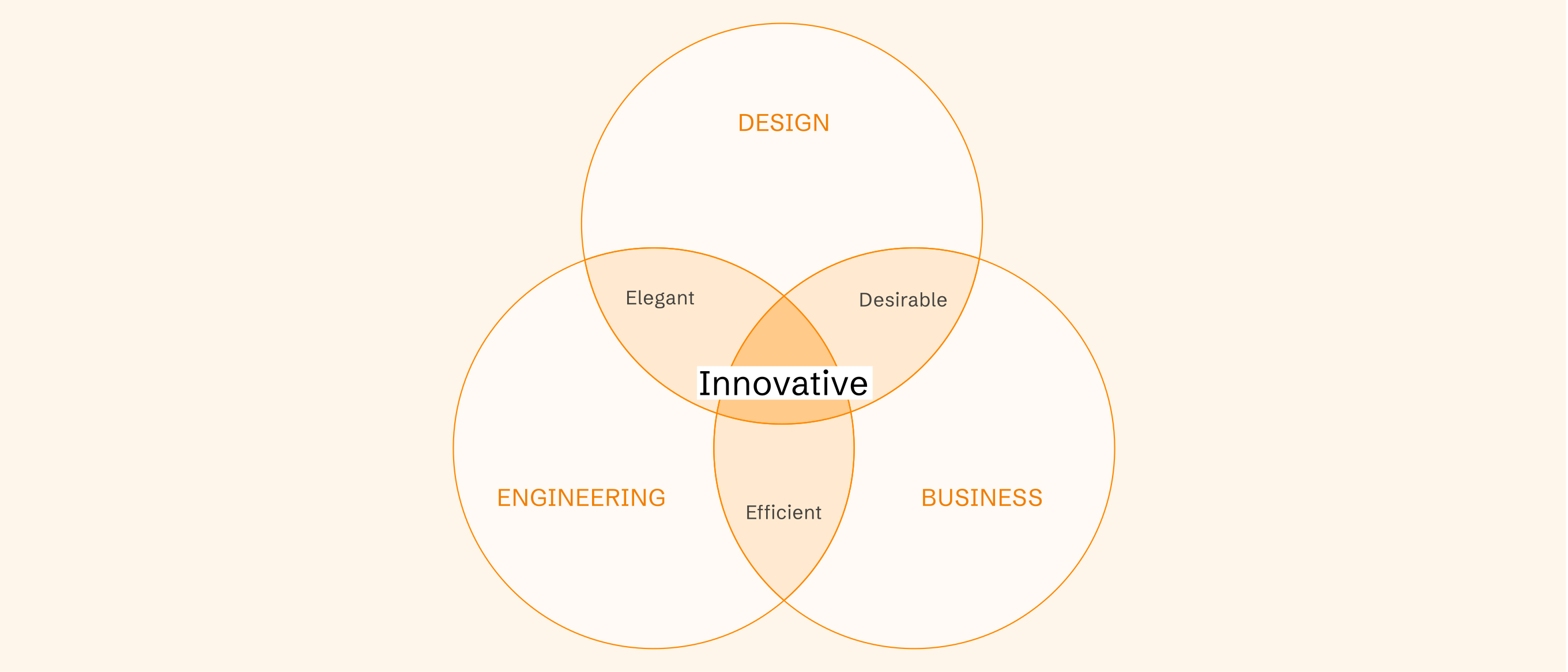
At Bang Creations, we believe great product innovation lives at the intersection of three disciplines: design, engineering, and business.
- Design keeps the human, (and the planet), at the heart of the problem. It is the emotion and the empathy; the discipline that identifies what is really needed and searches for solutions on a human scale.
- Engineering takes that design intent and delivers it, adding value at every step, circling back constantly to ask whether the solution can be simpler, more efficient, more honest.
- Business is where reality bites. Will this solution be adopted? By whom? At what cost? Through what channel? If the economics are out of balance, the best-designed, best-engineered product will fall on unfertile ground.
The Design Compass, Bang’s proprietary innovation tool, is built on exactly this thinking. Its inner ring quietly balances all three disciplines so that every decision is tested against design intent, engineering feasibility, and commercial viability simultaneously.
Innovation is what we specialise in. Not novelty for its own sake, but the purposeful creation of solutions that are genuinely needed, genuinely feasible, and genuinely marketable. We work through those three lenses before a single sketch is drawn.
Most product development projects do not fail in the design studio. They fail in the gap between design and manufacture, when a carefully conceived product meets tooling costs, material constraints, and minimum order quantities for the first time. Or they fail when a product reaches market and the target customer says: interesting, but not for me. End-to-end product development, done properly, closes both gaps; by design, and by process.
The product development spectrum: what different studios actually offer
Not every product design studio offers the same scope of service, and understanding the differences is genuinely useful before you begin any development project.
Industrial design studios focus purely on the form, function, and experience of a product. They are specialists in how something looks, feels, and behaves in human hands. Increasingly, this discipline encompasses human factors, the rigorous study of how people interact with products, services, and systems, which overlaps significantly with service design. When it comes to physical products, human-centred thinking at this stage is invaluable: defining ergonomics, user journeys, and interaction principles before a material or manufacturing process is chosen. Industrial designers tend to concentrate on CMF (colour, material, and finish) and will typically pass developed concepts to product development or technical engineering teams for the production journey.
Prototype houses are skilled fabricators whose clients are typically product development studios, engineering teams, and companies like Bang. They work from supplied input data. This is typically CAD files, technical drawings, detailed specifications, and they turn that data into physical prototypes with precision and speed. They do not own the design intent and are not set up to manage the development journey. If you approach a prototype house directly without that input data already prepared, you will need a design and development partner to get you there first.
Product design consultancies take on more of the development journey. A good product designer will always consider how their design will be made, in what materials, and how it will be assembled. These considerations are woven into the design process, not added at the end. Industrial designers tend to focus this thinking on CMF and form; product designers apply it more broadly, across structure, mechanism, assembly sequence, and component count. Many use the term “design for manufacture” to describe this capability, and in good hands it is real and valuable.
Full-service product innovation studios are genuinely rare. At the larger end, they are substantial organisations home to the full spectrum of disciplines under one roof, from human factors researchers and experience designers through to mechanical and production engineers. At the smaller end, studios like Bang Creations can only offer what they do because of one thing: thirty years of doing it. An extensive network of trusted manufacturing partners, prototype suppliers, test houses, and specialist suppliers built over decades, including nine years having run Bang Creations Asia, our own manufacturing and production studio in China. Deep familiarity with the problems that appear at every stage of development, which means seeing them earlier, and finding the innovative solution before they become expensive. The result is that manufacturing and production expertise does not arrive at the end of the journey. It joins the conversation at the beginning, and it stays at every decision point alongside the design and engineering disciplines throughout.
What separates studios on this spectrum is not talent; most are talented. It is ambition. Are they designing something beautiful to hand over, or are they invested in whether it actually works, sells, and lasts? At Bang, we only consider a project finished when it is in production and in the hands of the people it was designed for.
Why the gap between design and manufacture is where most products fail
The product development process has a well-known danger zone. It sits between the moment a design is signed off as a concept and the moment a manufacturer sees it for the first time.
In that gap, assumptions accumulate. The chosen material may not be available at the required specification. The manufacturing process that seemed obvious may produce a unit cost that makes the product commercially unviable. The tooling required may be far more complex and expensive than anticipated. Features that look elegant in CAD may be impossible to assemble at scale.
But there is an earlier danger zone that is talked about less. It sits between the first exciting idea and a concept that has been genuinely tested against business reality. Will anyone buy it? At what price? Through what channel? A product can be beautifully designed and perfectly engineered and still fail because those questions were never honestly answered before the investment was made.
None of these are failures of imagination. They are failures of process. And they are almost entirely preventable when design, engineering, and commercial thinking operate together from the very beginning.
At Bang Creations, manufacturing and commercial partners join the conversation at the concept stage. What we design, we know can be made. What we cost, we know is real. That is not a constraint on creativity. It is what makes the creative work count.
What “design for manufacture” really means, and what it doesn’t
“Design for manufacture” has become one of the most widely used phrases in product development. It is also one of the most inconsistently applied.
At its most basic, DFM means designing a product so that it can be manufactured efficiently, considering materials, tolerances, assembly sequences, and production processes during the design phase rather than after. This is sound practice. The problem is how loosely the term is used in reality.
When clients arrive at Bang having had design work done elsewhere, the pattern is familiar. There is a render. There is an exploded view with components labelled. There may be a note suggesting suitable materials. It looks considered. But when you examine it closely, nobody has asked what it will actually cost to make those parts. Nobody has specified the tooling required, or assessed its complexity. And almost nobody has thought through how the product gets assembled; in what sequence, by whose hands, at what speed, at what cost per unit. These are not minor details. They are the decisions that determine whether a product is commercially viable or not.
Good DFM is not a review that happens at the end of design. It is a discipline that runs through every stage and it only works when the engineering conversation is happening at the same time as the design conversation, not after it. How a part is formed affects how it looks. How it is assembled affects how it is designed. How much it costs to make determines whether anyone can afford to sell it.
This is where the business discipline becomes inseparable from the design and engineering. A product that is beautifully designed and cleverly engineered but costs three times too much to manufacture is not a solution. It is an expensive problem. The innovative approach, the one that sits at the centre of the Venn diagram, finds the innovative answer that satisfies all three: a product that is elegant, efficient, and commercially real.
That is the standard we apply at Bang. Not DFM as a checkbox. As a creative constraint that makes the design better.
What a Market Validated Prototype (MaVP) means in practice
Many people talk about a Minimum Viable Product (MVP); the smallest thing you can put into the world to test an idea. At Bang, we work toward something different: a Market Validated Prototype (MaVP), a stage and term we developed as part of our own process.
A MaVP is the point in development where you can stand in front of your target market and say, with confidence: “It will look like this. It will work like this. It will cost this much.” The product has been designed and engineered enough to be representative of the final item, your manufacturing partners have confirmed it can be made, and the business case has been tested with real people in the real market.
It sits at the end of the design and development phase and at the beginning of manufacture and production. Reaching MaVP is the moment you can make an informed decision about the next level of investment, typically tooling, larger-scale engineering, software deployment, and production, with the biggest risks already surfaced and addressed.
Learn more about MaVP and how we build it
How Bang Creations developed its end-to-end process, and why it works
Bang Creations did not start life as a generic “design consultancy.” It grew out of a career spent sitting at the intersection of design, engineering and business. Before founding Bang in 1999, Stefan designed furniture and lighting, then moved into engineering vacuum cleaners for Electrolux, before joining Hasbro and working across teams responsible for turning new ideas into mass-market products for global brands. That journey, from one-off pieces, to engineered appliances, to high-volume consumer products, built a deep respect for both the creative spark and the hard realities of manufacture, cost and retail.
When Bang Creations launched, the early work was in toys and games, where speed, innovation and commercial pressure are all intense. Clients quickly realised that the team could do more than come up with innovative ideas and solution. They could design what they conceived, engineer what they designed, and manage that engineering all the way into production. Over time, the sectors broadened, into furniture, baby products, beauty, fashion, sport, DIY, healthcare and connected devices, but the core pattern stayed the same: concept, development, manufacture and market were all part of one continuous journey.
Crucially, Bang has not only taken clients’ products to market; the team has taken its own ideas from sketchbook to shelf, securing international distribution both online and on the high street. Running Kickstarter campaigns, shipping via Amazon and other e-commerce channels, and negotiating retail distribution has given the studio first-hand experience of what it really takes for a product to sell, be supported, and scale. That experience now feeds directly back into every client project.
Over more than two decades and hundreds of innovation projects, this practice evolved into a structured process. It is now formalised in the Design Compass and in the workshops Bang runs with partners such as the British Library’s Business & IP Centre. It is a process that keeps design intent, engineering feasibility and commercial reality in balance from day one. When Bang describes itself as an end-to-end product development company, it is because that is how it has always worked: staying with a product from the first question to the first product off the production line if required.
Six questions to ask any studio before you trust them with your idea
- How will you help us understand if this really is a viable product opportunity? You are looking for a partner who can turn a rough idea into a clear value proposition, with a defined target user and route to market, not just a list of features.
- How do you test and validate ideas before we invest in tooling or large development costs? The important part is how representative that testing is. Listen for language about building prototypes that are close to the final product in how they look, feel and work, testing them with real users and manufacturing partners, and using that evidence as a clear go, refine or stop decision.
- When and how do you involve manufacturers and suppliers? The answer should not be “at the end”. You want manufacturing and production thinking present in the early concept conversations, not only at handover.
- What does your process look like between concept sign-off and production handoff, and what happens when a design needs to change for manufacture, who manages that? Design changes for production are normal. Who owns that conversation, and how are your interests protected? This is the gap where most problems occur, so ask for it to be described specifically.
- How do you design for sustainability and responsibility as well as commercial success? Look for a measurable, proven approach rather than vague statements. Ideally there is a framework or tool they use on every project to balance environmental and social impact with viability, not just good intentions.
- Can you show us products you have taken from idea to market, and tell us what you learned along the way? Renders are reassuring. Products that have been on shelves, online and in people’s homes are proof.
What to expect when you work with Bang Creations
We work with innovation teams inside established companies, as well as inventors, entrepreneurs and start-ups who need a partner that will stay the course from the earliest idea through to a product that is in production, on brief, and ready for its market.
Our process is built around three broad phases: Discover (research, brief and market strategy), Develop (concept, design, engineering and prototyping), and Deliver (manufacturer engagement, production management and market support). Throughout all three, the Design Compass guides every decision, helping us keep design intent, engineering feasibility and commercial reality in balance while minimising negative impact on people and planet.
We are very happy to take a project all the way through to production or to be one part of its journey. Different businesses and teams have different strengths; we aim to become an extension of your team rather than a supplier at arm’s length.
If you are at the stage where you need clarity on what your project actually requires, whether that is a conversation about scope, a Design Compass review of an existing idea, or a full end-to-end development partnership, we would be glad to hear from you.
Bang Creations is a certified B Corp product design and innovation studio based in Haslemere, Surrey, with a studio in Bristol and London meeting rooms at the British Library Business & IP Centre. Founded in 1999, we have delivered several hundred innovation projects, taken our own and our clients’ products to international markets online and on the high street, and won awards including a D&AD Sustainable Design Award (silver pencil). We are long-term workshop partners of the British Library Business & IP Centre and creators and authors of the Design Compass.